
The Expertise No Credential Captures
- Mark Fukae
- Apr 4
- 6 min read

What a decade of caregiving builds - and why Colorado law doesn't see it yet.
By Mark Fukae - Director of Advocacy - Professionals Who Care
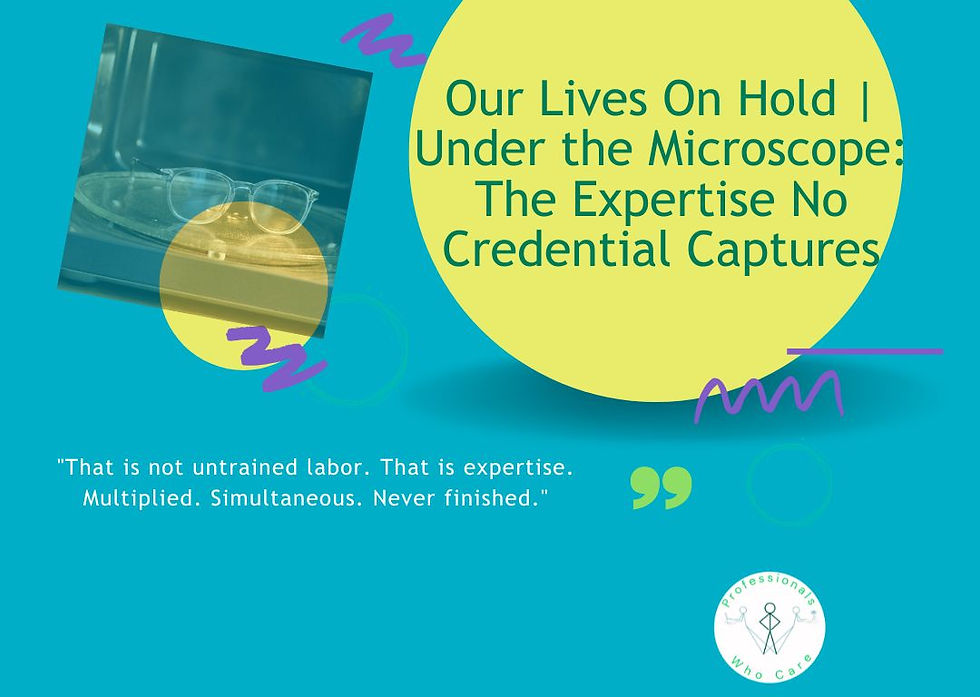
The glasses are in the microwave again.
My wife knows before she checks. That's what ten years of learning someone's new geography does to you. Her mother Rose's reading glasses, nested on the turntable as if placed there deliberately - which, in Rose's internal geography, they were. She doesn't say anything. She takes them out, sets them on the counter, makes the coffee.
By the time I get to the office, the glasses have already been found, the question has already been asked, and my wife has already answered it.
"When are you taking me home?"
"You're having dinner with us tonight. Come sit down."
One day at a time. That is what she does. And none of it appears in any HR system, any accommodation request form, or any protected class statute in Colorado.
On weekends and when the opportunity comes, the relay shifts. My wife needs a nap. My wife needs an afternoon that isn't organized around someone else's needs. So I take Rose - shopping, an outing, somewhere that gives my wife the house and the quiet and the reprieve she has earned. This is also caregiving. Not the primary weight, which my wife carries, but the relief valve that makes carrying it sustainable. The law does not see this either. It does not see the relay. It does not see the person who steps in so the person who is always there can briefly not be.
The Calculation Every Employed Caregiver Makes
My wife does not talk about this at work. Not because she has chosen silence - because the system has made silence the rational calculation. The moment an employed caregiver says I am a caregiver to a supervisor or HR department, they have handed over a lens. A lens through which their commitment, reliability, and trajectory will be evaluated - informally, quietly, with no paper trail.
That lens is not fair. Whether using it is legal depends on a set of conditions most caregivers cannot meet, inside an enforcement infrastructure that is being systematically dismantled.
De jure - what the law technically says - there are narrow protections. Denver and a handful of Colorado localities have local ordinances prohibiting family responsibilities discrimination. Federal law offers some protection when discrimination can be traced to sex stereotyping or disability association. On paper, something exists.
De facto - what actually happens in practice - it is nearly unreachable. And in April 2026, less reachable than at any point in recent decades.
The proof problem alone disqualifies most caregivers. To assert a federal claim, a caregiver must prove not just that bad things happened to their career, but that the employer's motive was discriminatory - that sex or a protected characteristic was the driving factor. Creative dismissal leaves no such evidence. A restructured role. A shifted project.
Performance standards that quietly tighten. A promotion that goes to someone else with no explanation offered. These are the ordinary tools of institutional power. No paper trail. No claimable discriminatory act. The most common mechanism by which caregiving careers end is precisely the mechanism existing law cannot see.
Then add the enforcement environment. The EEOC - the federal agency responsible for investigating workplace discrimination - is operating at nearly half its 1980 staffing level, with a proposed further budget cut of $19.6 million for fiscal year 2026. The agency has announced it will no longer process complaints alleging disparate impact - the legal theory that makes patterns of discrimination visible in aggregate when they are invisible in any individual case. The infrastructure for seeing systemic discrimination is being removed at the same moment the individual pathway to proving discrimination is already nearly impossible.
Then add the broader climate. We are operating inside an administration that has made the assertion of workplace rights feel professionally dangerous. The chilling effect documented inside the federal civil service radiates outward into every employment relationship. When the message from the top is that accommodation is weakness, the rational calculation shifts: you do not name what you are carrying. You make yourself legible as someone without needs.
And beneath all of it: the power dynamic itself. My wife's supervisor has information my wife needs them not to have. The institution has memory. The moment she names what she carries, she has handed a lens to people who will not forget it. No discriminatory intent required. The social dynamics of institutional power operate on information regardless of law. The person with less power in that room knows this, calibrates accordingly, and says nothing.
This is not a personal failure. It is a rational response to a documented structural reality.
The absence of a protected class statute does not sit at the top of this problem. It sits at the bottom - the foundation on which everything else rests. Without it, the narrow federal protections remain narrow. The local ordinances remain local. The enforcement agency remains defunded and redirected. The proof burden remains impossible. And the power dynamic remains exactly what it is: a system that benefits from silence and has arranged itself to produce it.
The Credential Bias We Need to Name
We call people like my wife "uncredentialed." The word is accurate - no nursing degree, no license, no formal healthcare training. But it implies a deficit. A gap between what she does and what a "real" healthcare professional does.
That framing is wrong.
What my wife has is not the absence of credentials. It is years of experiential competency, specific to two people simultaneously, built through sustained attention and love, that no nursing school teaches and no credential confers.
She is the primary caregiver for her mother Rose - learning Rose's new geography, tracking each progression, mapping the expanding radius of what Rose can no longer hold. And she is part of the caregiving relay for my mother, who has lived with us since 2016, whose dementia runs on its own separate timeline. Two people. Two progressive conditions. Two maps being learned and relearned at the same time, each changing on its own schedule, neither pausing for the other.
She knows which behavior in Rose is new this week. She knows the difference between a plateau and a progression - in both of them. She knows what "when are you taking me home?" means on a Tuesday versus what it means at 3 AM, and she knows it means something slightly different depending on who is asking. That is not untrained labor. That is expertise - multiplied, simultaneous, never finished. The Colorado CARE Act is built on that recognition.
There is a second bias worth naming: the word "family." We use it to mean a relative providing unpaid care - but caregiving is not only a family function. Neighbors who take in someone with no one else. Friends who reorganize their professional lives around a person who has been abandoned. People who do this work not because of blood or law but because it is the human thing to do. The CARE Act is built on the recognition that caregiving relationships are not determined by biology. They are determined by presence, commitment, and the fact that someone showed up.
What the Statute Would Do
The Colorado CARE Act - proposed for the 2027 legislative session - would add family caregiver status as a protected class under the Colorado Anti-Discrimination Act. It would require reasonable workplace accommodations through an interactive process, using the POWR Act as the zero-cost precedent. It would prohibit creative dismissal - the pattern of restructuring, reassigning, or constructively terminating employees whose caregiving responsibilities become inconvenient.
Zero general fund appropriation. Projected $9 to $18 million in annual Medicaid savings by preventing unnecessary institutionalizations. Effective July 1, 2028.
It would allow my wife to say - without calculation, without fear, without the practiced silence of someone who has learned the truth about her life is professionally dangerous:
I am a caregiver. This is what I do. Colorado sees me.
What You Can Do
Read and listen to the full piece at The Revenue Neutral Caregiver on Substack: therevenueneutralcaregiver.substack.com
Sign the Colorado CARE Act petition: https://chng.it/DLWncS9wtT 755 signatures, 675 supporters. The goal is 1,000.
If you are a Colorado caregiver - employed, unemployed, credentialed, uncredentialed, related or not - your story is the evidence this legislation needs.
Contact: mark_fukae@casiadvocacy.org
She put the glasses back. Made the coffee. Answered the question. Went to work. Said nothing.
Colorado's employment law calls that silence the natural order of things.
We are working to change the law.
Mark Fukae is the Director of Advocacy for Professionals Who Care and the founder of CASI. He is a registered Colorado volunteer lobbyist developing the Colorado CARE Act for the 2027 session.


Comments