
Caregivers, Medicaid Cuts, and the Workplace We Are Not Talking About Enough
- Joanna P. Schofield
- Dec 29, 2025
- 2 min read
We are not talking enough about what Medicaid cuts will mean for the people sitting next to us at work.
Behind policy debates and budget lines are millions of employed caregivers who rely on Medicaid-funded home- and community-based services to make work possible. When those supports are reduced or eliminated, caregivers do not just lose services. They absorb new direct and indirect costs, lose stability, and face impossible choices between employment and care.
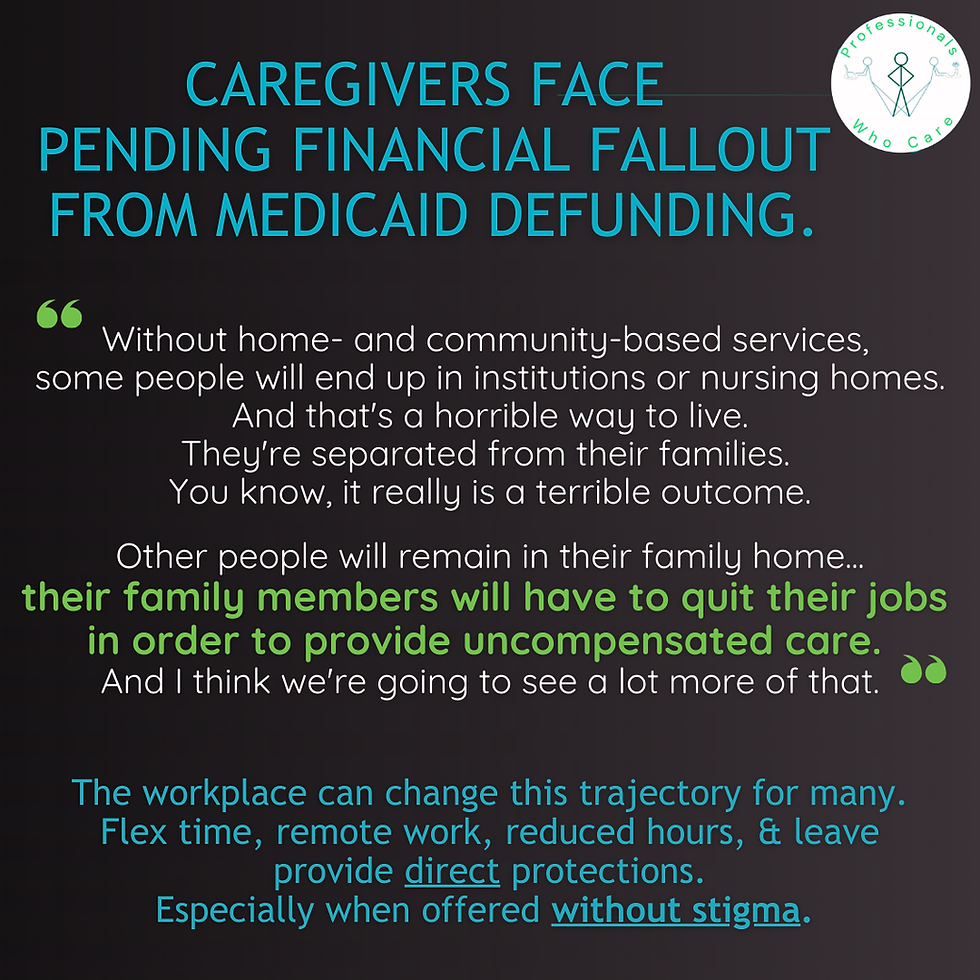
Without home- and community-based services, some people will be forced into institutions and separated from their families. Others will remain at home, but only because a family member leaves the workforce to provide unpaid care. In both scenarios, caregivers pay the price, financially, professionally, and personally.
The Workforce Impact We Are Overlooking
Caregivers are already subsidizing our health care system with unpaid labor. Medicaid cuts deepen that burden.
As Ari Ne’eman, Assistant Professor of Health Policy and Management at Harvard T.H. Chan School of Public Health, explains in a recent interview, these cuts will push more caregivers out of the workforce entirely. When services disappear, families do not suddenly have more capacity. Someone has to fill the gap, and that someone is usually a working family member.
In an interview conducted by Vin Gupta, a public health physician and pulmonologist, Ne’eman outlines how reduced Medicaid funding creates a cascade of consequences. Caregivers leave jobs. Household income drops. Long-term financial insecurity grows. Employers lose skilled, experienced team members they did not intend to lose.
This is not a niche issue. It is a workforce issue.
✅ Watch the interview: https://www.youtube.com/watch?v=q06FUKWhw9A
Financial Fallout for Caregivers Is Both Immediate and Long Term
Caregivers affected by Medicaid cuts face rising out-of-pocket costs, lost wages, stalled careers, and reduced retirement savings. These impacts compound over time, especially for women, people of color, and families already navigating structural inequities.
Professionals Who Care has documented the growing financial burden caregivers carry and the long-term consequences when safety nets fail.
✅ Read more about the caregiver financial burden:https://www.professionalswhocare.org/caregiver-burden
The Workplace Can Change the Trajectory
An inclusive workplace for caregivers is one of the most effective antidotes to further harming our country’s carers, who will face both immediate and long-term financial fallout from these decisions.
Flexible schedules, remote work, reduced hours, and protected leave are not perks. They are stabilizers. When offered without stigma, these policies allow caregivers to remain employed, maintain income, and continue contributing their skills and leadership.
This moment calls for employers to recognize what public systems are no longer providing and to respond with humanity, foresight, and practicality. Retaining caregivers is not just the right thing to do. It is essential for workforce resilience and the future of work.
Care for the carers must include care at work.


Comments